PAH and PH-ILD at a glance

Not all pulmonary hypertension (PH) is the same. The World Health Organization (WHO) groups PH into broad categories based on the perceived cause of the vascular injury. Both PAH and PH-ILD lead to elevated blood pressure in the pulmonary arteries, resulting in heart and lung damage and a decreased lifespan for patients.2

PAH

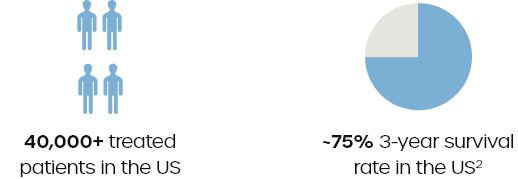
WHO GROUP 1* Infographic showing that over 40,000 patients are treated in the US and have an approximately 75% 3-year survival rate.

*WHO Group 1 refers to PAH, which is caused when the arteries in the lungs become narrowed, thickened, or stiff. As a result, the right side of the heart must work harder to push blood through these arteries.2

PH-ILD

WHO GROUP 3* Infographic showing the estimated prevalence of a condition (diagnosed and undiagnosed) is over 60,000 people in the US with an approximately 35% 3-year survival rate.

*WHO Group 3 includes PH due to chronic lung disease. PH-ILD includes a diverse collection of up to 150 different pulmonary diseases, including interstitial pulmonary fibrosis (IPF), chronic hypersensitivity pneumonitis, connective tissue disease (CTD)–related ILD, and chronic pulmonary fibrosis with emphysema (CPFE), among others.3

Focusing on the potential of inhaled treprostinil

Treprostinil is one of the most widely used prostacyclin analogs for the treatment of PAH and is the only FDA-approved therapy for the treatment of PH-ILD.

Clinical benefits of prostacyclin therapy are well-established and include reduced symptoms of pulmonary hypertension, improved prognostic measures of risk, such as exercise capacity and functional class, and delayed disease progression.4

When inhaled, prostacyclin analogs like treprostinil have the potential to offer substantial benefits over other methods of administration, potentially reducing systemic side effects and providing faster onset than oral formulations.5

References:

  1. Nikkho SM, Richter MJ, Shen E, et al. Clinical significance of pulmonary hypertension in interstitial lung disease: A consensus statement from the Pulmonary Vascular Research Institute’s innovative drug development initiative-Group 3 pulmonary hypertension. Pulm Circ. 2022;12(3):e12127. Published 2022 Jul 1. doi:10.1002/pul2.12127
  2. Hendriks PM, Staal DP, van de Groep LD, et al. The evolution of survival of pulmonary arterial hypertension over 15 years. Pulm Circ. 2022;12(4):e12137. Published 2022 Oct 1. doi:10.1002/pul2.12137
  3. Kacprzak A, Tomkowski W, Szturmowicz M. Pulmonary Hypertension in the Course of Interstitial Lung Diseases-A Personalised Approach Is Needed to Identify a Dominant Cause and Provide an Effective Therapy. Diagnostics (Basel). 2023;13(14):2354. Published 2023 Jul 13. doi:10.3390/diagnostics13142354
  4. Mitchell JA, Ahmetaj-Shala B, Kirkby NS, et al. Role of prostacyclin in pulmonary hypertension. Glob Cardiol Sci Pract. 2014;2014(4):382-393. Published 2014 Dec 31. doi:10.5339/gcsp.2014.53
  5. Harrison W. Farber, Wendy Gin-Sing. Practical considerations for therapies targeting the prostacyclin pathway. European Respiratory Review Dec 2016, 25 (142) 418-430; DOI:10.1183/16000617.0083-2016